






EXECUTIVE SUMMARY
The main objective of the research is to improve the understanding of the behavior of structures under realistic fire conditions, including cooling phases, in order to support the development of a design method to achieve fire resistance until complete extinction (burnout resistance).
This method, considered as a supplement to the fire resistance index R, would make it possible to quantify an index of resistance to extinction which reflects the capacity of an element to survive throughout the duration of a realistic fire. Recent progress has been made in this direction, especially with numerical studies, but experimental data were needed.
To this end, the objective of this project is to experimentally study the response of columns of different materials under thermal exposure comprising a heating phase followed by a cooling phase. The main idea is that several identical columns will be tested successively under fires of increasing duration, in order to define the longest « realistic fire » that a column can survive until the complete extinction of the fire. It is obvious (from physical considerations and numerical models) that the duration of the heating phase of this longest fire will be shorter than the standard fire resistance, but this has never been explicitly demonstrated by a series of experiments like the one proposed in this research program.
In other words, the R classification system makes it possible to understand the performance of structural elements under conventional fire.
It does not make it possible to ensure that two structural elements with the same classification R will have the same behavior under a “natural” fire including a cooling phase.
The program includes 2 phases, the first one consisted in a series of furnace test, using both the conventional fire curve and the DHP methodology, on concrete and timber elements. The second phase (still in progress) was planned to investigate the behavior of timber column under “natural” fire test.

Figure 1 : Illustration of the DHP principle.
Overview of the experimental campaign of the natural fire tests
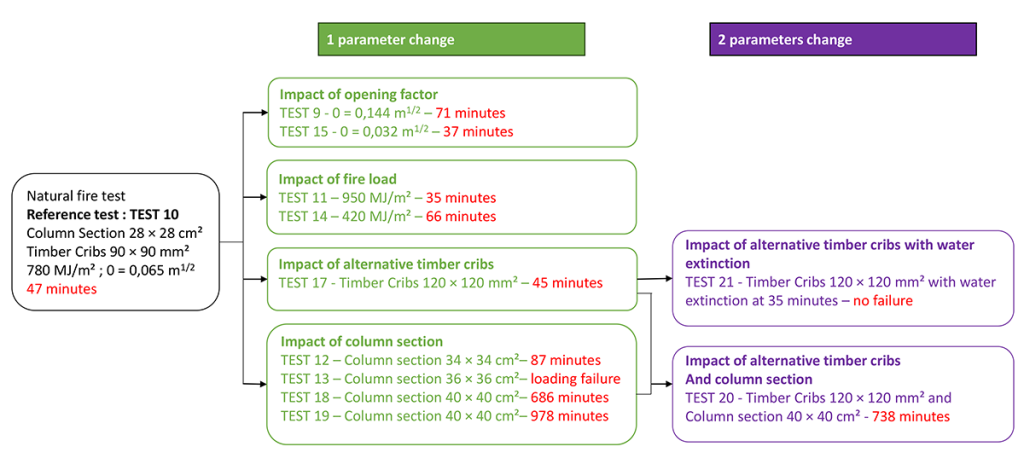 Figure 2 : synoptic view of the current advancement of experimental program of the natural fire tests phase 2. The failure times are indicated in red.
Figure 3 : View of the test 20, the center plot shows the mean temperature in the compartment as measured by the plate thermometers. The plot on the right shows the temperature inside the timber column.
Tests data
Furnace fire tests on concrete elements – Liège University
Standard test
Available on 2024-08
DHP tests
Available on 2024-08
Furnace fire tests on glulam 28 × 28 cm² elements – IBMB
Standard test
| Test | Description | Duration of fire resistance | Test reports | Data |
| TEST 1 | fixed – hinged ISO | 78 minutes | Available on 2024-08 | |
| TEST 2 | Hinged – hinged ISO | 55 minutes | Available on 2024-08 | |
| TEST 5 | Hinged – hinged ISO | 58 minutes | Available on 2024-08 | |
| TEST 16 | Hinged – hinged ISO | 48 minutes | Available on 2024-08 | Available on 2024-08 |
DHP tests
| Test | Description | Duration of fire resistance | Test reports | Data |
| TEST 3 | Hinged – hinged DHP 15 | 98 minutes | Available on 2024-08 | |
| TEST 4 | Hinged – hinged DHP 10 | No failure | Available on 2024-08 | |
| TEST 6 | Hinged – hinged DHP 15 | 153 minutes | Available on 2024-08 | |
| TEST 7 | Hinged – hinged DHP10 | No failure | Available on 2024-08 |
Natural fire tests on glulam elements – CERIB
Reference test
| Test | Description | Duration of fire resistance | Test reports | Data |
| Natural fire test TEST 10 |
|
47 minutes |
 10
101 parameter change
| Parameter changed | Test | Description | Duration of fire resistance | Test reports | Data |
| Opening factor | TEST 9 | 0 = 0,144 m1/2 | 71 minutes | ||
| TEST 15 | 0 = 0,032 m1/2 | 37 minutes | |||
| Fire load | TEST 11 | 950 MJ/m² | 35 minutes | ||
| TEST 14 | 420 MJ/m² | 66 minutes | |||
| Alternative timber cribs | TEST 17 | Timber Cribs 120 × 120 mm² | 45 minutes | ||
| Column section | TEST 12 | Column section 34 × 34 cm² | 87 minutes | ||
| TEST 13 | Column section 36 × 36 cm² | Loading failure | |||
| TEST 18 | Column section 40 × 40 cm² | 686 minutes | |||
| TEST 19 | Column section 40 × 40 cm² | 978 minutes |
2 parameters change
| Parameters changed | Test | Description | Duration of fire resistance | Test reports | Data |
| Alternative timber cribs with water extinction | TEST 21 | Timber Cribs 120 × 120 mm² with water extinction at 35 minutes | No failure | ||
|
Alternative timber cribs and column section |
TEST 20 | Timber Cribs 120 × 120 mm² and column section 40 × 40 cm² | 738 minutes |
Publications
- Renard et al. “Parametric experimental study on GLT columns stability during natural fire tests including the cooling phase,” Proceedings of the 13th International Conference on Structures in Fire (SiF2024). 2024.
- F.Robert et al., “Natural fire tests on GLT columns including the cooling down phase,” in World Conference on Timber Engineering (WCTE 2023), Oslo, Norway: World Conference on Timber Engineering (WCTE 2023), 2023, pp. 1848–1854. doi: 10.52202/069179-0244.
- “079 – Timber columns failure in the decay phase with Thomas Gernay and Jochen Zehfuss,” Fire Science Show, Dec. 07, 2022. [Online]. Available: https://www.firescienceshow.com/079-timber-columns-failure-in-the-decay-phase-with-thomas-gernay-and-jochen-zehfuss/
- T. Gernay et al., “Experimental investigation of structural failure during the cooling phase of a fire: Concrete columns,” Fire Safety Journal, vol. 134, p. 103691, Dec. 2022, doi: 10.1016/j.firesaf.2022.103691.
- T. Gernay et al., “Experimental investigation of structural failure during the cooling phase of a fire: Timber columns,” Fire and Materials, vol. n/a, no. n/a, Oct. 2022, doi: 10.1002/fam.3110.
- T. Gernay, “Stabilité structurelle : Burnout Resistance,” presented at the Colloque de sciences appliquées au sapeur-pompier, Paris, France, May 03, 2022.
Project Team
The tests are performed in the framework of a collaborative partnership involving the following authors.
 |
 |
 |
 |
 |
 |
 |
| Pr Thomas Gernay | Pr Jean-Marc Franssen | Pr Jochen Zehfuß | Dr Robert Jansson McNamee | Pr Patrick Bamonte | Dr Fabienne Robert | Dr Silvio Renard |
|
Department of Civil and Systems Engineering, Johns Hopkins University, USA |
Liège University |
Technische Universität Braunschweig (IBMB-Braunschweig), Division of Fire Safety |
RISE Fire Research |
Department of Civil and Environmental Engineering (DICA),, Politecnico di Milano, Italy |
CERIB |
|
Project Team
The tests are performed in the framework of a collaborative partnership involving the following authors.
|
| Pr Thomas Gernay |
|
Department of Civil and Systems Engineering, Johns Hopkins University, USA |
|
| Pr Jean-Marc Franssen |
|
Liège University |
 |
| Pr Jochen Zehfuß |
|
Technische Universität Braunschweig (IBMB-Braunschweig), Division of Fire Safety |
 |
| Dr Robert Jansson McNamee |
|
RISE Fire Research |
 |
| Pr Patrick Bamonte |
|
Department of Civil and Environmental Engineering (DICA),, Politecnico di Milano, Italy |
 |
| Dr Fabienne Robert |
|
CERIB |
|
| Dr Silvio Renard |
|
CERIB |
Partners’ websites


Whith the support of